
Further Reading

Bio-microneedling or skin needling: which one suits your skin right now?
Two treatments, almost the same name, sitting next to each other on the one menu. They are not the same thing, and the difference is depth. Our new guide sets out which complaints each one can reach, what the week afterwards asks of you, and how thin the evidence still is on the newer one.

Eyebrow tattoo gone grey or too dark: correct it, remove it, or wait it out?
Grey-blue brows, or brows that came out heavier than you agreed to, have three ways out, and only one of them is usually right for you. Our new post sets out colour correction, removal and waiting. It includes where laser is the better call, and the one risk it carries that belongs to cosmetic pigment.
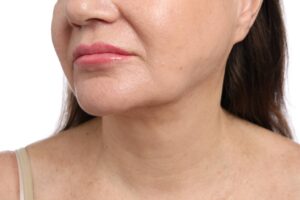
HIFU for a sagging jawline, jowls and neck: what it can and can’t lift
HIFU by age, best age for HIFU; HIFU in your 40s / 50s / 60s, too young or too old for HIFU, HIFU prevention vs correction, Uncontested age-suitability longtails, no tracked volume, foundational-content play.
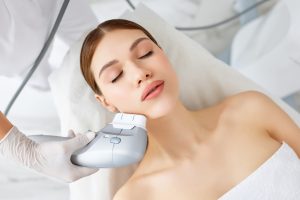
Is HIFU worth it at your age? What to expect in your 40s, 50s and 60s
HIFU by age, best age for HIFU; HIFU in your 40s / 50s / 60s, too young or too old for HIFU, HIFU prevention vs correction, Uncontested age-suitability longtails, no tracked volume, foundational-content play.
HIFU for jawline, neck and jowls: realistic results
Compare plasma skin tightening and HIFU for laxity, eyelids, jawline, downtime, healing, and realistic treatment fit.
Plasma skin tightening vs HIFU: which fits the concern?
Compare plasma skin tightening and HIFU for laxity, eyelids, jawline, downtime, healing, and realistic treatment fit.
Skin tag removal: what to know before booking
Body sugaring is often seen as an alternative hair removal method, but many clients use it long term. This article explains why.
Eyebrow tattoo – styles, what to expect, and how to choose the right look
Body sugaring is often seen as an alternative hair removal method, but many clients use it long term. This article explains why.
Lip tattoo explained – what to expect, healing, and how long it lasts
Body sugaring is often seen as an alternative hair removal method, but many clients use it long term. This article explains why.
Do Clients Stick With Body Sugaring Long Term?
Body sugaring is often seen as an alternative hair removal method, but many clients use it long term. This article explains why.
What is HIFU, and how does it tighten skin?
Someone has told you HIFU is the non-surgical option for skin that has lost its firmness. Maybe you saw it on a price list. Maybe a friend has had it done. What nobody explained is what the letters stand for, or what the treatment does under your skin.
HIFU stands for high intensity focused ultrasound. It uses sound waves, focused so they meet at a set depth below the surface, to heat tiny points of tissue. Those points reach around 60 to 70 degrees. The body repairs them by building new collagen over the following weeks, and that is what firms the skin. The surface is never broken.
What is HIFU?
HIFU is short for high intensity focused ultrasound. It is a non-surgical skin tightening treatment that uses focused sound waves to heat tissue below the surface of the skin.
Ultrasound is sound at a pitch too high for people to hear. It is the same type of energy used to scan a baby during pregnancy. HIFU uses a much higher intensity and aims it differently. Rather than passing through the body to make a picture, the waves are angled so they meet at one small point. That works the way a magnifying glass concentrates sunlight. At that point, and only at that point, the tissue heats to around 60 to 70 degrees. Everything the sound passes through on the way stays cool, including the skin surface.
You may also come across the term somewhere completely different. HIFU was developed as a medical treatment for tumours. It is still used that way for prostate cancer and uterine fibroids. The cosmetic version uses far less energy and works a few millimetres down, rather than deep inside the body.
How does HIFU tighten skin?
HIFU tightens skin by making small, controlled points of heat damage at depth. The body repairs them by producing new collagen. Collagen is the protein that gives skin its firmness and structure.
Here is the part that matters most.
HIFU does not add firmness from the outside. It asks your skin to make its own.
So the change you see depends on how much collagen your skin can still produce. That is why the same treatment, on the same setting, gives one person a clear result and another very little. Our guide to why HIFU results vary goes through the reasons. If your question is whether that adds up to something worthwhile at your stage of life, we cover HIFU in your 40s, 50s and 60s separately.
Depth is the other thing that shapes the result. Devices deliver energy at set depths, and each one does a different job.
Lower face as a whole Blend these areas so the result looks even, not patchy Match the result of a surgical lift
| Depth | What sits at that level | What treating it changes |
|---|---|---|
| 1.5 mm | The upper layers of the skin | Fine lines and surface texture |
| 3.0 mm | The deeper skin, where most collagen sits | Firmness and thickness of the skin |
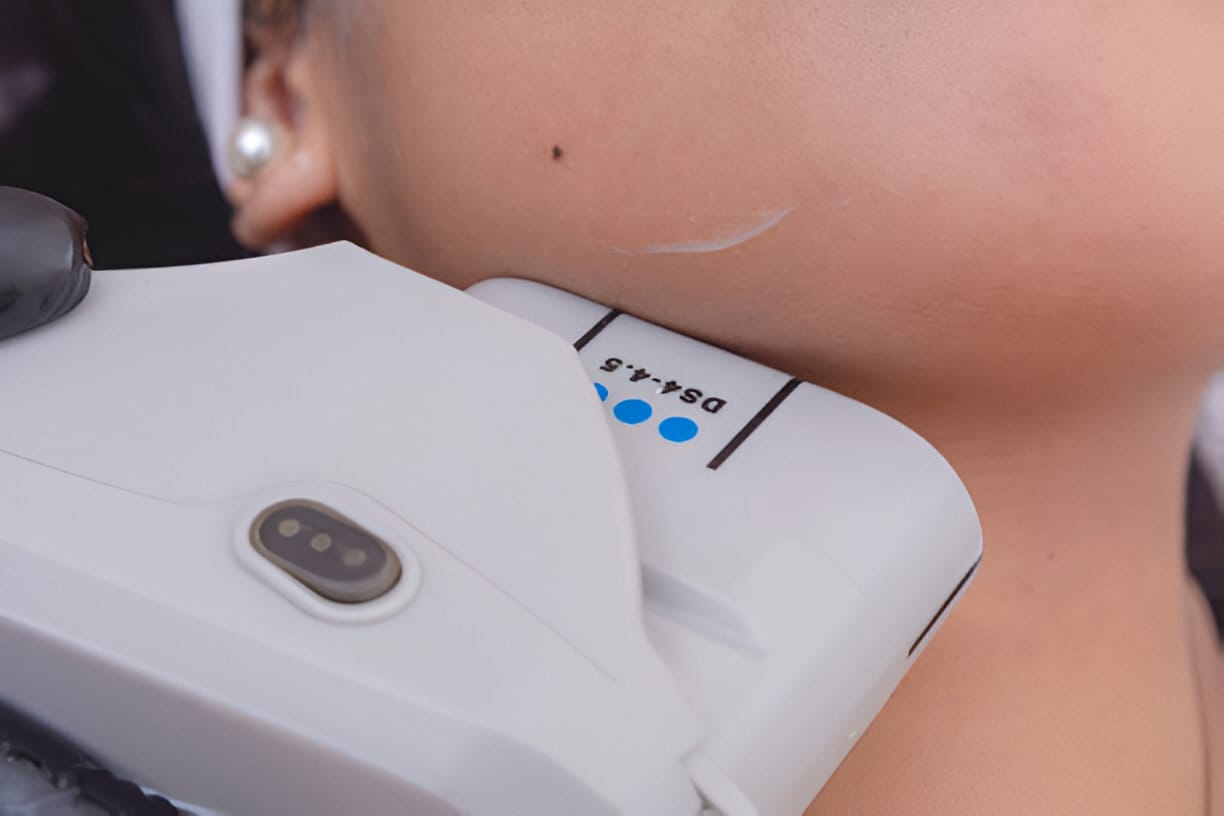
| 4.5 mm | The firm support layer beneath the skin | The lift through the jaw and neck |
More than one depth can be treated in the same session. That is why a single treatment can change both surface texture and the support underneath it.
What does HIFU treat?
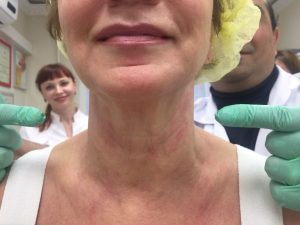
HIFU suits skin that has lost firmness, rather than skin with heavy loose folds. It is used most often on the lower face and jawline, the neck and under the chin, the brow, and the décolletage.
Softening along the jaw is a common reason people ask about it. So is a brow that sits lower than it used to, or crepey skin on the neck. Where there is a lot of loose skin, HIFU will not lift it, and something else will suit you better.
If the jawline, jowls or neck are your concern, our piece on HIFU for the lower face covers that area properly.
What happens during a HIFU treatment?
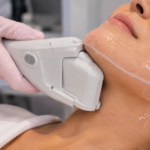
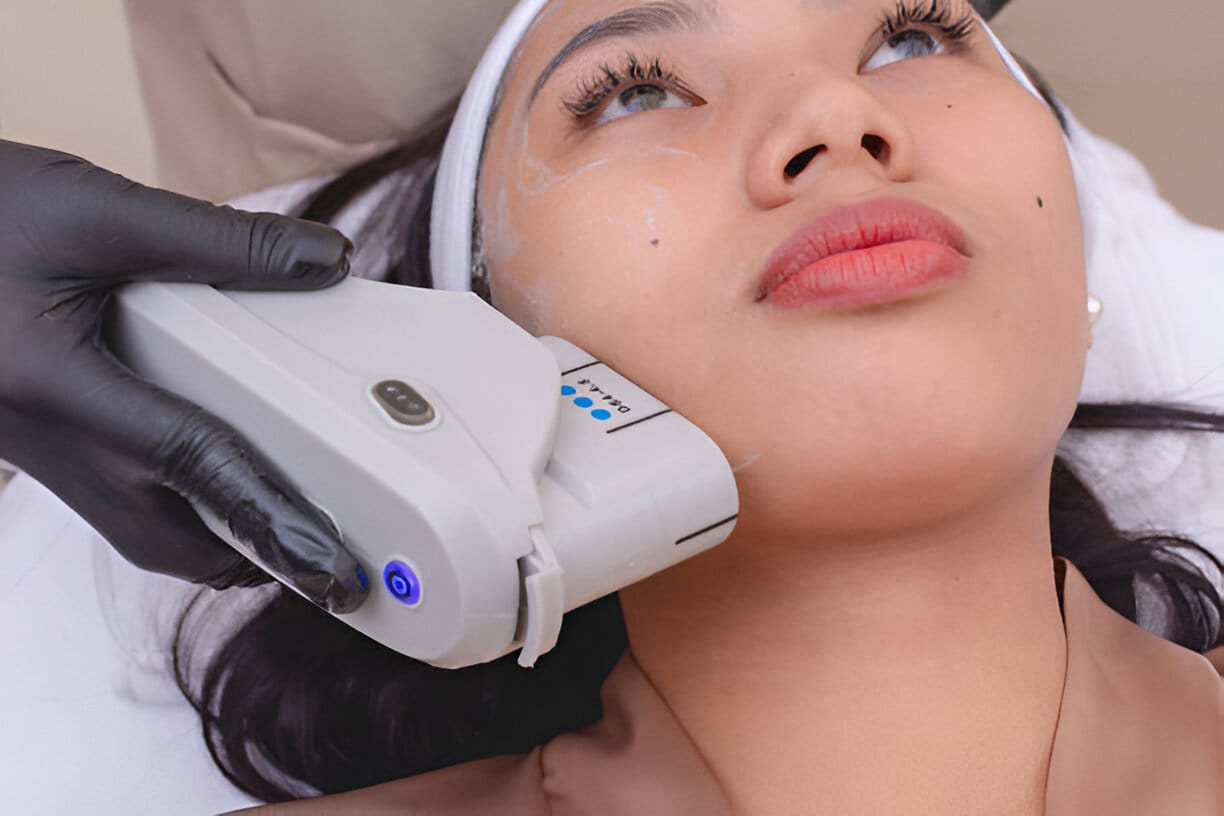
Your skin is cleaned, a gel is applied, and the handpiece is moved over the area in lines. As each line is delivered you feel heat and a deep prickling or tingling. It comes in short bursts of a few seconds.
It is not painless. The sensation is short-lived, but it is strong enough that you should know about it before you are on the bed, not during. Many people find it manageable. It is sharpest over bone, so the jaw and brow tend to be the strongest, while the cheeks and neck are usually easier. It stops the moment each line finishes.
Session length depends on the area being treated. There is no downtime afterwards. Skin often looks pink and can feel tender or slightly puffy. That usually settles within a few hours. Some people stay tender to the touch for a week or two, particularly along the jaw. You can put makeup on and go back to work the same day.
How many HIFU treatments do you need?
The number of HIFU treatments you need is settled at a consultation. It depends on three things: how much firmness your skin has lost, how large the area is, and how much change you are after.
Skin with mild looseness and good collagen activity needs less. A larger area, or skin that has lost more support, may need more. Timing matters as much as the number. Collagen keeps building for months after a session. Reviewing your skin before that has finished tells you very little.
What you should get from a consultation is a plan with a number in it and a review date. If nobody will say how many sessions they expect, or when they will look at your skin again, ask why before you pay for anything.
Is HIFU safe, and who is it not for?
HIFU is non-invasive, does not break the skin, and comes from a technology with a long clinical history in medicine. Side effects are usually limited to redness, mild swelling and tenderness, and they settle on their own.
Suitability is the bigger question, and it has two parts. The first is safety. HIFU is not suitable during pregnancy or breastfeeding. It is not suitable if you have a metal or electronic implant, such as a pacemaker, in or near the treatment area. It is not done over active infection, cold sores, broken skin, or a skin condition that is flaring in the area. If you have had fillers or threads, the timing needs checking before you book, because heat can affect them.
The second part is whether it will do anything worth paying for.
- Advanced looseness. Once skin has lost real support, HIFU will not lift it. Surgery is the treatment that does, and we compare the two in our post on HIFU and traditional facelifts.
- Very little collagen activity left. Skin with less capacity to build collagen has less to work with, whatever the settings on the machine.
- Hollowing rather than sagging. Flattening through the cheeks is a loss of volume, not slack skin. Tightening will not bring that back.
Suitability is judged in person, not from a photo. If HIFU is not the right fit, plasma skin tightening works differently and suits a different set of concerns.
Before you book
What decides whether HIFU is worth doing is not your age. It is not the name of the treatment on the price list either. It is how much collagen activity your skin still has. Skin that springs back when you move it behaves differently under HIFU to skin that stays where you put it. Two people born in the same year can sit at opposite ends of that. It is read by hand, in a few seconds, and it is the first thing worth asking about.
At For the Love of Beauty in Hornsby, the same person does the consultation, the treatment and the review. What gets assessed is your skin, not a template. Book a consultation, and if HIFU is not the right treatment for what is bothering you, you will be told so, along with what would suit better.